

Explore the future of India China Geopolitics and discover how economic growth, AI, manufacturing, military power, and human capital will shape the global balance of power by 2050.
Table of Contents
Introduction
The 21st century is witnessing one of the most significant geopolitical contests in modern history: the rise of India and China as competing centers of global influence. While China has spent the last four decades transforming itself into the world’s manufacturing powerhouse, India is positioning itself as a technology-driven, innovation-led, and demographically advantaged nation.
The debate surrounding India China Geopolitics is no longer limited to border disputes or trade balances. It now encompasses artificial intelligence, supply chains, military power, critical minerals, global institutions, and the race to shape the future world order.
As both countries continue to expand their economic and strategic footprints, a critical question emerges:
Will China maintain its dominance, or will India emerge as the next global superpower by 2050?
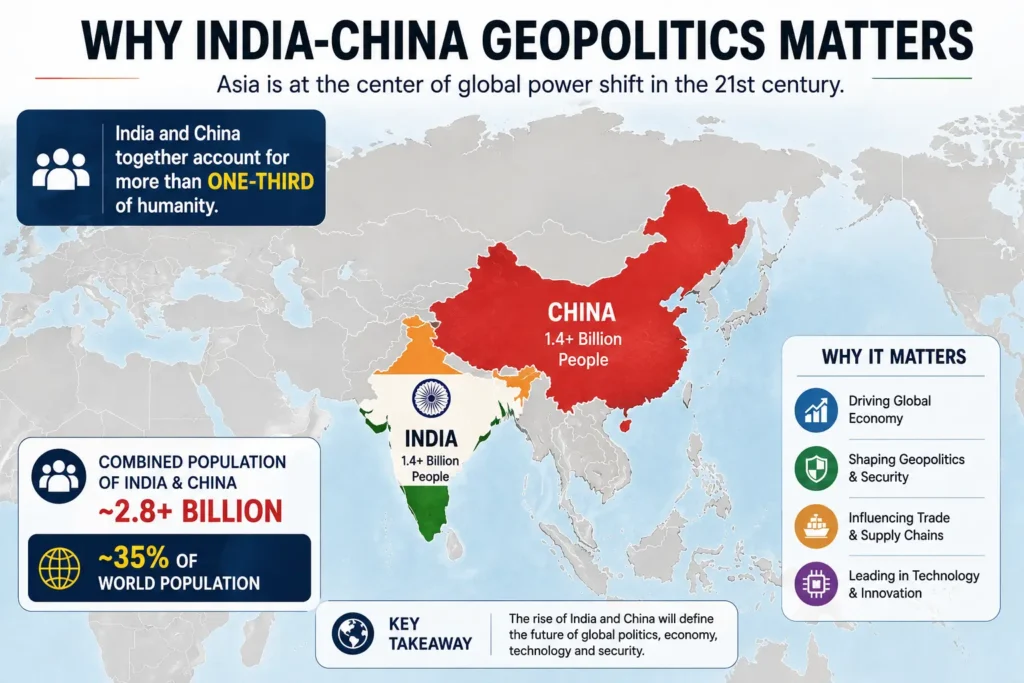
Why India-China Geopolitics Matters
The global balance of power is shifting eastward.
For much of the 20th century, the international system was largely shaped by the United States and its Western allies. However, the rapid economic rise of Asia has fundamentally altered that equation.
Today:
- China is the world’s second-largest economy.
- India is among the fastest-growing major economies.
- Together, they account for more than one-third of humanity.
The trajectory of these two nations will significantly influence global trade, technology, energy markets, security alliances, and international institutions for decades to come.
China’s Dominance Playbook
China’s rise was not accidental. It was the result of long-term strategic planning, massive infrastructure investment, and an unwavering focus on industrial development.
Economic Expansion Through Global Influence
One of China’s most ambitious initiatives is the Belt and Road Initiative (BRI), a global infrastructure network spanning Asia, Africa, Europe, and Latin America.
Through investments in ports, railways, highways, and energy projects, China has expanded its economic reach across dozens of countries.
For an overview of the initiative, visit the official Belt and Road Portal:
Critics argue that some infrastructure projects have increased financial dependence on China, while supporters view them as catalysts for economic development.
Regardless of perspective, the initiative has undeniably enhanced China’s geopolitical influence.
Manufacturing: The Foundation of Chinese Power
China’s manufacturing ecosystem remains one of its greatest strengths.
The country has built:
- Vast industrial clusters
- Efficient logistics networks
- Deep supply chains
- Massive export capabilities
From smartphones and solar panels to industrial machinery and electric vehicles, China dominates production across numerous sectors.
This manufacturing advantage provides economic strength while also creating strategic leverage over global supply chains.
Control Over Critical Resources
Modern economies depend heavily on critical minerals and rare earth elements.
These resources are essential for:
- Semiconductors
- Electric vehicles
- Renewable energy systems
- Defense technologies
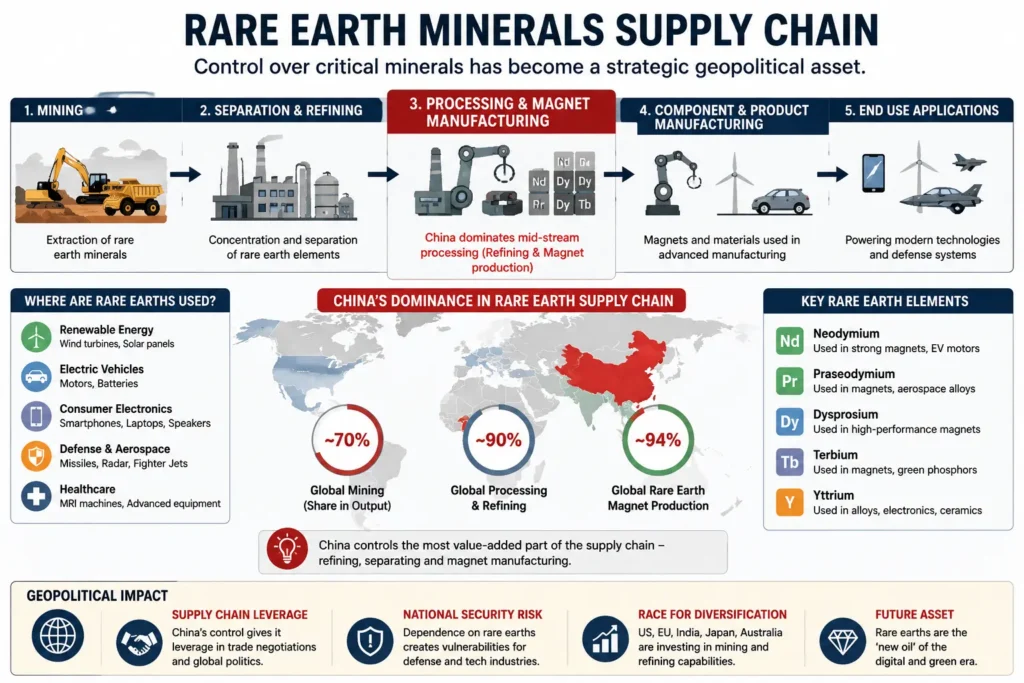
China has invested aggressively in mining, refining, and processing capabilities, giving it significant influence over global supply chains.
Technology and Strategic Influence
China’s geopolitical strategy increasingly extends into:
- Artificial Intelligence
- Digital Infrastructure
- Telecommunications
- Data Governance
By combining economic strength with technological capabilities, China seeks to shape international standards and emerging technologies.
China’s Core Formula
Manufacturing + Resources + Infrastructure + Technology = Strategic Influence
India’s Strategic Path to Global Leadership
India’s approach differs fundamentally from China’s model.
Rather than relying solely on centralized industrial expansion, India is leveraging its strengths in democracy, digital infrastructure, entrepreneurship, and human capital.
Digital Public Infrastructure: India’s Unique Advantage
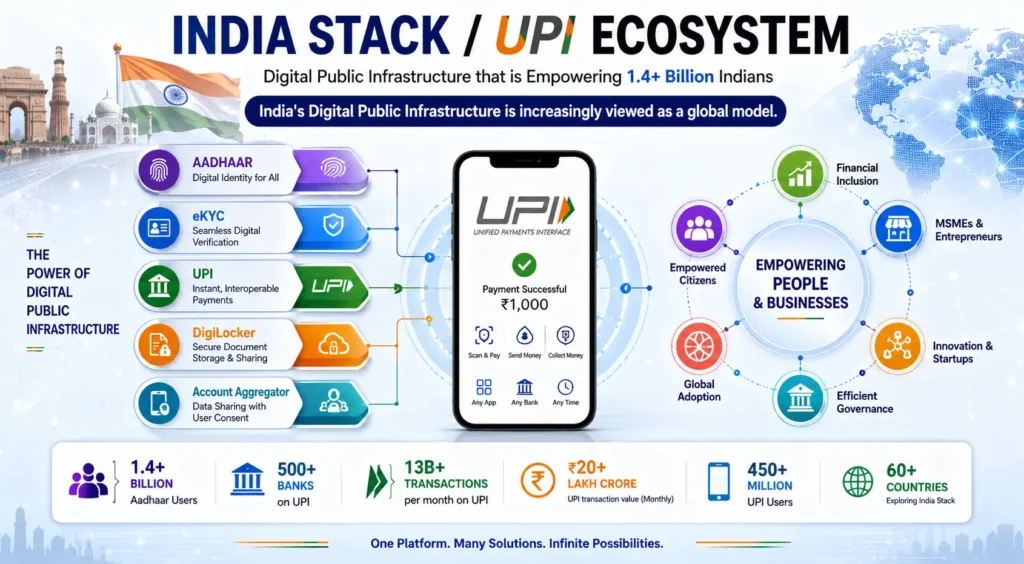
One of India’s most remarkable achievements has been the development of Digital Public Infrastructure (DPI).
Initiatives such as:
- Aadhaar
- UPI
- DigiLocker
- CoWIN
have demonstrated how technology can be deployed at population scale.
India’s digital payments ecosystem, particularly UPI, has become a global case study in financial inclusion and digital transformation.
Learn more through the official India Stack platform:
Many policymakers worldwide now view India’s digital infrastructure as a potential model for developing economies.
Manufacturing and Industrial Growth
India recognizes that sustainable economic power requires a strong manufacturing base.
To accelerate industrial growth, the government has launched initiatives such as:
- Make in India
- Production Linked Incentive (PLI) Schemes
- Semiconductor Mission
- Electronics Manufacturing Programs
The objective is clear:
Move from being a service-driven economy to becoming a major global manufacturing hub.
Security and Defense Modernization
Economic growth alone does not guarantee geopolitical influence.
Recognizing this reality, India has significantly expanded investments in:
- Defense modernization
- Naval capabilities
- Border infrastructure
- Indigenous weapons development
As the Indo-Pacific becomes increasingly important, India’s strategic location provides a unique geopolitical advantage.
India’s Core Formula
Demographics + Democracy + Digital Infrastructure + Innovation = Strategic Potential
The Three Major Battlegrounds
1. Artificial Intelligence and Technology
Technology will likely determine geopolitical leadership in the coming decades.
Key areas of competition include:
- Artificial Intelligence
- Semiconductor Manufacturing
- Cybersecurity
- Quantum Computing
- Advanced Computing Infrastructure
China possesses vast manufacturing capabilities and large-scale data ecosystems.
India, meanwhile, benefits from a globally recognized technology workforce and a rapidly expanding startup ecosystem.
The country that leads in AI and advanced technologies may ultimately gain a decisive strategic advantage.
2. Global Architecture and Trade Routes
Control over trade routes has historically been a key determinant of geopolitical power.
Critical regions include:
Indian Ocean
The Indian Ocean carries a substantial portion of global trade and energy shipments.
South China Sea
This region remains strategically vital for China’s maritime ambitions.
Malacca Strait
One of the world’s most important maritime chokepoints, connecting the Indian Ocean and Pacific Ocean.
Any nation seeking global influence must secure access to these critical trade corridors.
3. Human Capital
Perhaps India’s greatest long-term advantage is its population.
Over the next several decades, India will continue to possess one of the world’s largest working-age populations.
However, demographics alone do not guarantee success.
To fully capitalize on this advantage, India must strengthen:
- Education systems
- Research institutions
- Skill development
- Innovation ecosystems
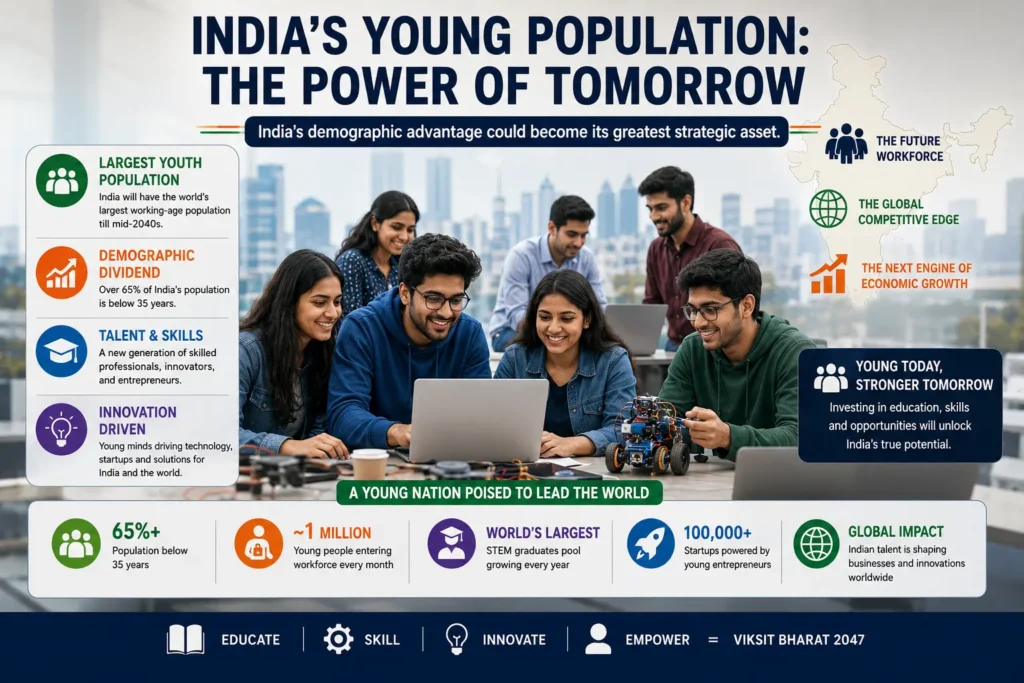
If successfully managed, India’s demographic dividend could become one of the defining drivers of global growth.
Challenges India Must Overcome
While India’s potential is significant, several challenges remain.
Manufacturing Gap
China’s industrial ecosystem remains far larger and more integrated than India’s.
Research and Development
India’s R&D spending remains relatively low compared to leading innovation-driven economies.
Infrastructure Development
Although significant progress has been made, logistics efficiency and industrial infrastructure require continued investment.
Education Quality
Building a globally competitive workforce will require substantial improvements in higher education, technical training, and research capacity.
Scenarios for 2050
Scenario 1: China Retains Leadership
China continues to dominate manufacturing, technology, and global infrastructure networks, preserving its position as Asia’s leading power.
Scenario 2: India Closes the Gap
India successfully expands manufacturing, invests heavily in AI, improves education outcomes, and becomes a leading innovation economy.
In this scenario, India emerges as a major global superpower.
Scenario 3: Dual Asian Superpowers
Perhaps the most realistic outcome is a world where both nations succeed.
In this future:
- China remains the world’s manufacturing powerhouse.
- India becomes a global leader in talent, digital infrastructure, and innovation.
Together, they reshape the global order while competing and cooperating simultaneously.
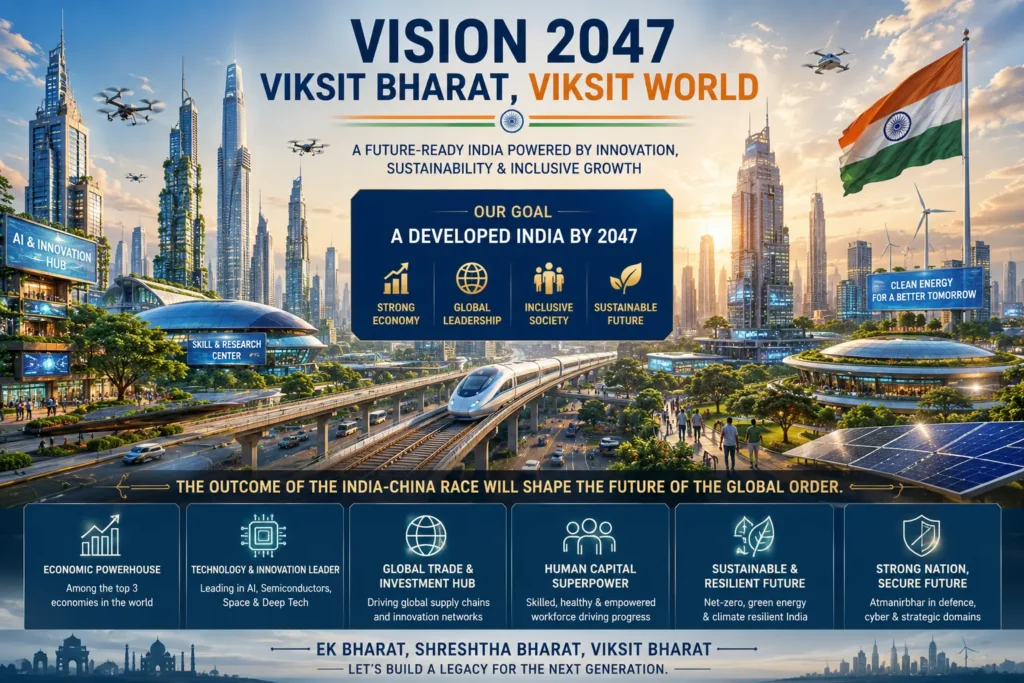
The Verdict: Who Will Win?
The future of India China Geopolitics cannot be reduced to GDP rankings alone.
This rivalry is fundamentally about:
- Innovation
- Technology
- Strategic influence
- Economic resilience
- Human capital
- National vision
China built its power through manufacturing and infrastructure.
India’s opportunity lies in combining demographic strength, digital leadership, entrepreneurship, and technological innovation.
By 2050, the true winner may not be the country with the largest economy, but the one that most effectively shapes the institutions, technologies, and ideas that define the future world.
Conclusion
The India-China geopolitical race is not merely a contest between two nations. It is a struggle between different development models, strategic priorities, and visions for the future.
China has demonstrated the power of manufacturing-led growth and global infrastructure influence.
India is attempting to build a new model centered on digital public infrastructure, human capital, innovation, and democratic governance.
The coming decades will reveal whether India can transform its immense potential into sustained global leadership.
One thing is certain: the future of global geopolitics will be heavily influenced by the choices made in New Delhi and Beijing.
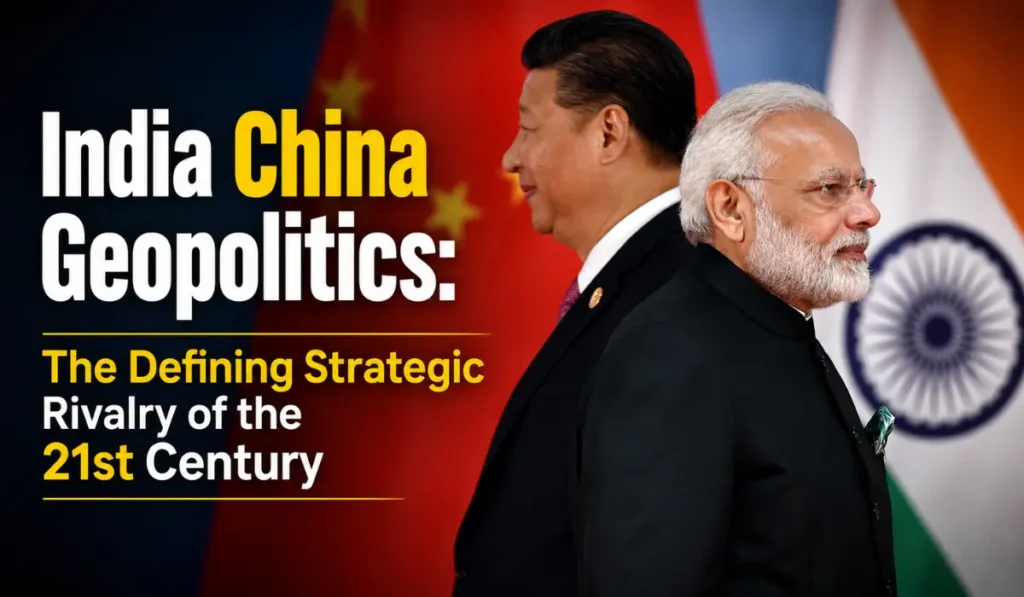
India’s Manufacturing Boom is gaining global attention. Can India replace China as the world’s factory, or are there deeper challenges ahead?