


Discover how the India Carbon Credit Market became a $6 billion opportunity in 2026. Learn about CCTS, carbon trading, and how to profit from going green.
Table of Contents
The Story of the “Invisible Crop”
Imagine a small-scale farmer in rural Maharashtra named Rajesh. For generations, his family grew cotton, praying for rain and haggling over market prices. But today, Rajesh is harvesting something invisible: Carbon.
By switching to “regenerative” farming—practices that trap carbon dioxide in the soil instead of releasing it—Rajesh isn’t just selling cotton; he’s selling Carbon Credit Certificates (CCC). Last month, a major airline in Delhi bought his “credits” to offset their flight emissions. Rajesh didn’t just survive the season; he thrived.
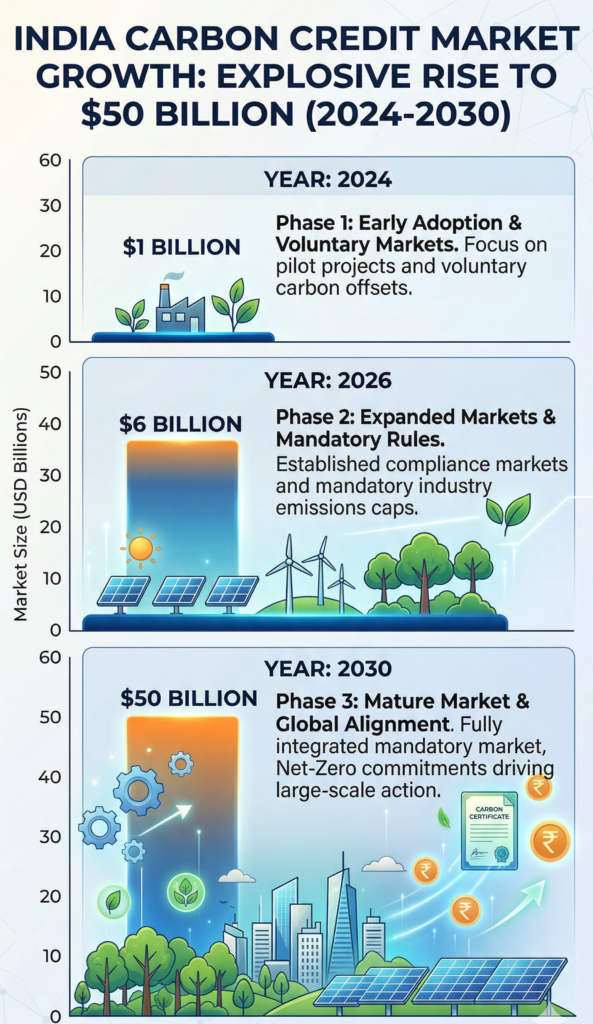
This isn’t a fairy tale. It’s the heartbeat of the India Carbon Credit Market, a sector that has exploded into a $6 billion opportunity as of early 2026.

Why the India Carbon Credit Market Matters Now
The India Carbon Credit Market is no longer just for environmentalists; it is the new frontier for Indian CFOs and entrepreneurs. As of April 2026, the Indian government has fully operationalized the Carbon Credit Trading Scheme (CCTS), making it mandatory for heavy industries—like cement, steel, and textiles—to track and trade their emissions.
Why is this happening?
- Global Pressure: With the EU’s Carbon Border Adjustment Mechanism (CBAM) now in effect, Indian exports must be “green” to stay competitive.
- Net Zero Targets: India’s commitment to Net Zero India 2070 requires a massive reduction in greenhouse gases.
- Economic Incentive: A market-based system turns “pollution” into a line item on a balance sheet that companies want to reduce to save money—or sell to make money.
Understanding the Basics: How It Works
For a beginner, the India Carbon Credit Market can seem like alphabet soup. Let’s break it down into two simple buckets:
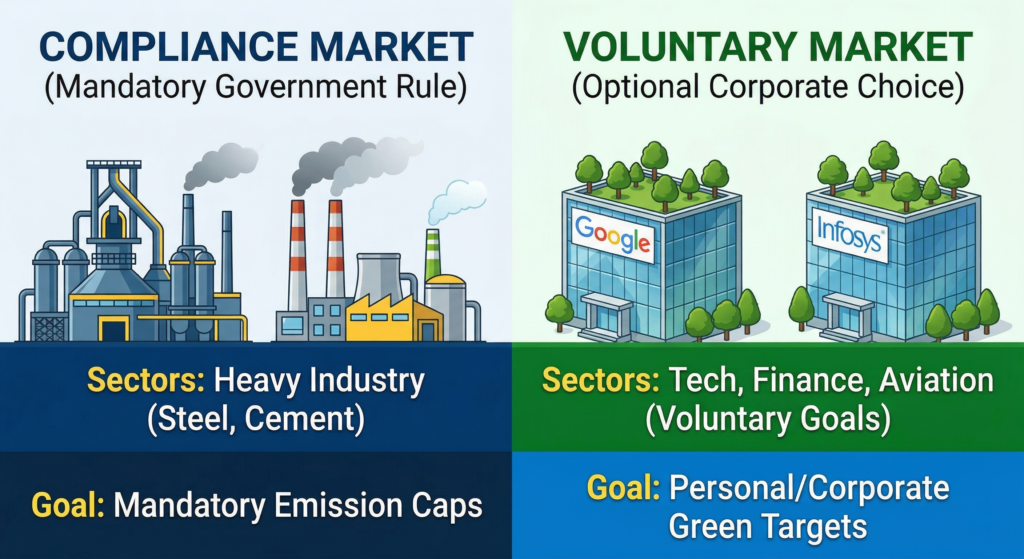
1. The Compliance Market (The “Have-To”)
- The government sets a “cap” on how much pollution a factory can produce.
- If a factory pollutes less than its limit, it earns Carbon Credit Certificates.
- If a factory pollutes more, it must buy credits from those who were cleaner.
- Target Industries in 2026: Aluminum, Cement, Petroleum Refineries, and Textiles.
2. The Voluntary Market (The “Want-To”)
- This is where companies like Google or Infosys buy credits voluntarily to meet their own “Green” goals.
- Credits here come from “projects”—like planting forests, installing solar pumps, or capturing methane from landfills.
Real-World Examples of the $6 Billion Opportunity
In 2025-26, we saw massive shifts that proved the scale of the India Carbon Credit Market:
- The Tech Giants: In early 2025, Google announced a massive deal to buy 100,000 tons of carbon credits from the Indian Biochar Initiative. This turned agricultural waste into “black gold” for Indian farmers.
- The Power Sector: Major players like Torrent Power and Adani Green are now earning more from their carbon offsets than from some of their traditional energy sales.
- Small Businesses: A textile mill in Surat upgraded its boilers to be 30% more efficient. Under the India Carbon Credit Market rules, those savings were converted into tradable credits, essentially paying for the equipment upgrade in less than two years.

Benefits for Beginners & Entrepreneurs
You don’t need a PhD in climate science to benefit from the India Carbon Credit Market.
- New Revenue Streams: If you own land or a small factory, “green” upgrades can literally pay for themselves.
- Job Creation: The market has created a desperate need for “Carbon Auditors,” “Sustainability Consultants,” and “Project Verifiers.”
- Investment Opportunities: Green energy startups are seeing record valuations because their “carbon potential” is now a measurable asset.
Risks and Challenges: The “Green” Reality Check
While the India Carbon Credit Market is booming, it isn’t without its thorns.
- Greenwashing: Some projects claim to save carbon but don’t. The government’s new Indian Carbon Market Portal (launched in March 2026) is designed to fix this with strict verification.
- Price Volatility: Like the stock market, the price of a carbon credit can swing. In early 2026, prices stabilized, but they can still be unpredictable.
- Complex Paperwork: Getting a project “verified” to earn credits is still a bureaucratic hurdle for many small players.
Actionable Tips: How to Start in 2026
If you want to tap into the India Carbon Credit Market, follow these steps:
- Conduct a Carbon Audit: Use a digital tool to see how much CO2 your home or business produces.
- Explore the Offset Mechanism: If you have land, look into “Nature-based Solutions” like agroforestry.
- Stay Informed: Follow the Bureau of Energy Efficiency (BEE) updates on the Carbon Credit Trading Scheme.
- Invest in Green Tech: From EVs to solar, every “green” choice is a step toward future-proofing your finances.
The Future Outlook: Towards 2030
The India Carbon Credit Market is projected to grow from $6 billion today to nearly $50 billion by 2030. We are moving toward a “One Nation, One Carbon Price” model. Eventually, even your personal EV might earn you micro-credits that pay for your charging.
Conclusion: The Green Gold Rush is Here
The India Carbon Credit Market is no longer a niche experiment. It is a fundamental shift in how India builds, grows, and profits. Whether you are a farmer like Rajesh or a corporate leader, the message is clear: Decarbonization is the new de-facto business strategy.
Ready to turn your green ideas into gold? Start by calculating your footprint today and join the $6 billion revolution.
[CTA: Download our “Beginner’s Guide to Carbon Trading in India” PDF below!]