

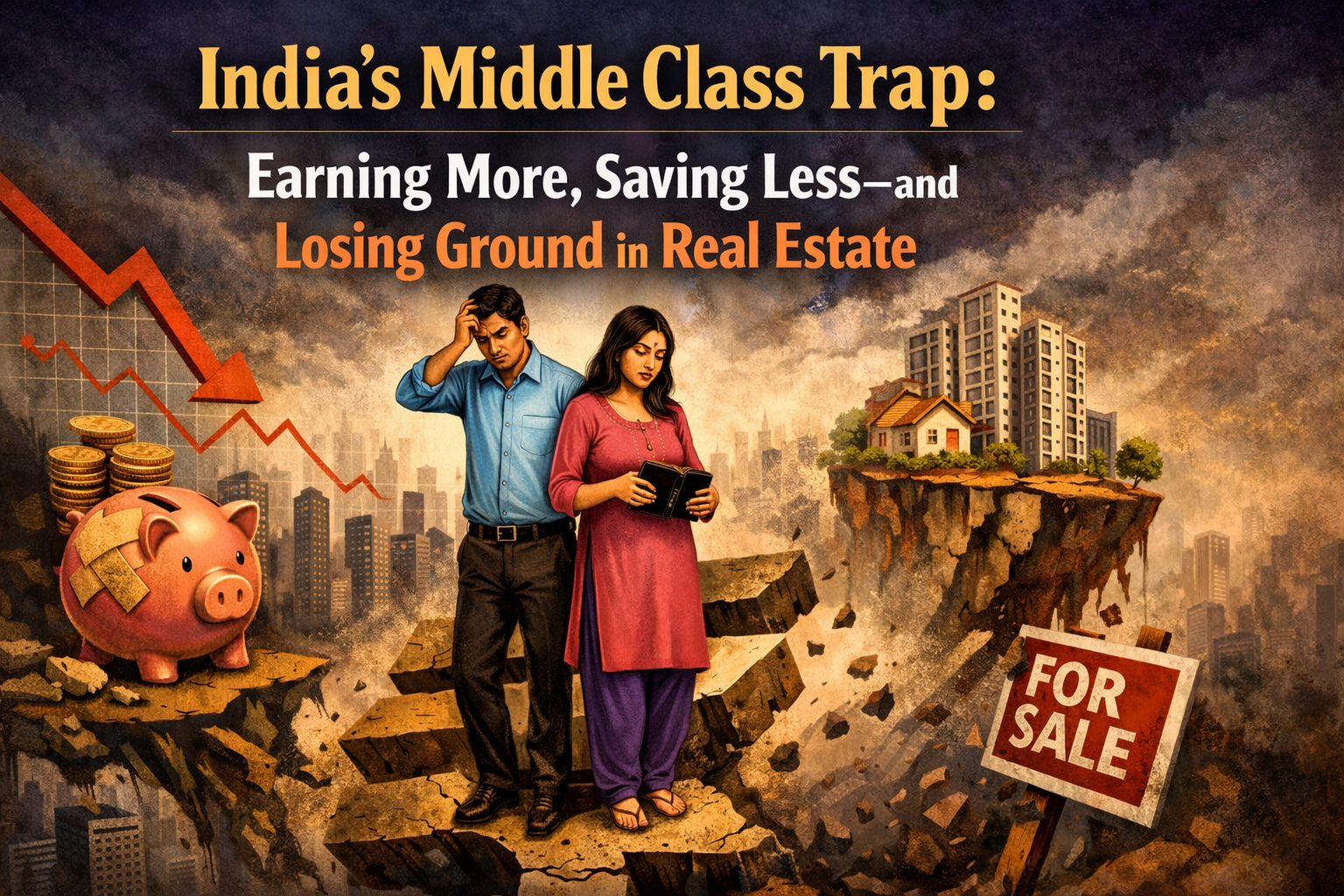
India’s Middle Class Trap is reshaping home buying and investments. Learn how rising income but low savings impacts real estate decisions.
Table of Contents
There’s a strange contradiction playing out across Indian cities right now. People are earning more, upgrading lifestyles, and stepping into bigger aspirations—yet financial stress hasn’t gone away. In fact, for many, it has increased.
This is exactly what defines India’s Middle Class Trap. You earn more, but somehow, you don’t feel richer.
In real estate, this problem becomes even more visible. Buying a home, which was once a symbol of stability, is now becoming a long-term financial commitment that many struggle to manage. I’ve seen young professionals in cities like Surat, Ahmedabad, and Bengaluru stretch their finances just to “own” a house.
And that’s where India’s Middle Class Trap quietly begins.
What Is India’s Middle Class Trap in Real Estate?
At its core, India’s Middle Class Trap is about a mismatch between rising income and actual wealth creation. It’s not that people aren’t earning enough—it’s that they’re not able to retain or grow what they earn.
In real estate, this shows up clearly:
- Buyers taking larger home loans than they should
- EMIs eating up a major portion of monthly income
- Minimal savings left after fixed expenses
A house becomes less of an asset and more of a long-term financial pressure point under India’s Middle Class Trap.
Income Growth vs Property Price Reality
Let’s look at a simple ground reality.
Yes, salaries have increased over the last decade. But property prices in urban India have grown faster in key markets. According to trends discussed in
https://en.wikipedia.org/wiki/Real_estate_in_India, demand in urban areas continues to push prices upward.
Here’s what typically happens:
- A buyer earning ₹12–15 lakh annually looks at ₹80 lakh–₹1.2 crore properties
- Developers market “premium living” as a necessity
- Buyers assume future income will cover today’s financial stretch
This optimism feeds directly into India’s Middle Class Trap.
Because income growth is uncertain—but loan obligations are not.
The EMI Culture: The Silent Financial Drain
One of the biggest contributors to India’s Middle Class Trap is the normalization of EMIs.
Today, home loans are easy to get. Banks offer flexible terms, longer tenures, and attractive interest rates. On the surface, it feels empowering.
But it changes behavior.
Instead of evaluating affordability, buyers start calculating EMI comfort.
What this leads to:
- 25–30 year loan commitments
- Reduced financial flexibility
- Constant dependency on stable income
According to https://en.wikipedia.org/wiki/Mortgage_loan, long-term mortgage obligations significantly impact liquidity and financial decision-making.
And this is where India’s Middle Class Trap becomes dangerous.
Lifestyle Inflation and Housing Decisions
Let’s be honest—real estate today is not just about shelter. It’s about status.
Buyers want:
- Prime locations
- Gated communities
- Luxury amenities
- Modern interiors
Nothing wrong with that. But when lifestyle drives decisions more than financial logic, India’s Middle Class Trap takes over.
I’ve personally seen buyers reject affordable properties in developing areas, only to overpay for smaller homes in prime zones. Why? Because of perception.
That choice often leads to:
- Higher EMIs
- Lower savings
- Delayed investments
And once again, India’s Middle Class Trap deepens.
Rent vs Buy: A Confusing Decision
This debate has become more relevant than ever.
Under India’s Middle Class Trap, buying a house is often seen as a necessity—even when it may not be financially ideal.
When buying makes sense:
- Stable income
- Long-term settlement plans
- Manageable EMI
When renting may be smarter:
- Frequent job changes
- Overpriced property markets
- Better investment opportunities elsewhere
Yet, many still buy due to social pressure or fear of missing out.
This emotional decision-making strengthens India’s Middle Class Trap.
Impact on Real Estate Investments
Middle-class investors are also caught in this cycle.
Instead of strategic planning, investments are often driven by trends:
- Buying under-construction properties without due diligence
- Investing based on hype rather than data
- Ignoring rental yield and cash flow
Under India’s Middle Class Trap, investment becomes speculative.
A more grounded approach would include:
- Studying location growth
- Understanding demand-supply dynamics
- Focusing on long-term returns
But emotional and social factors often dominate.
The Missing Financial Awareness
One major issue behind India’s Middle Class Trap is the lack of financial education.
Many buyers:
- Don’t calculate total cost (interest + maintenance + taxes)
- Underestimate risks
- Ignore emergency funds
Real estate decisions are made based on affordability today—not sustainability tomorrow.
That’s a risky approach.
Breaking India’s Middle Class Trap
Escaping India’s Middle Class Trap doesn’t require drastic changes. It requires smarter thinking.
Practical steps:
1. Buy Within Limits
Don’t stretch finances for status-driven purchases.
2. Prioritize Savings
Ensure savings and investments continue even after EMI commitments.
3. Evaluate True Cost
Look beyond property price—consider interest, maintenance, and opportunity cost.
4. Avoid Over-Leverage
Too much debt reduces flexibility.
5. Think Like an Investor
Even if buying for personal use, consider long-term value.
These steps can help reduce the grip of India’s Middle Class Trap significantly.
A Real-Life Snapshot
Let’s take a common scenario.
A salaried individual earning ₹20 lakh annually buys a ₹1.3 crore flat.
- EMI: ₹80,000/month
- Additional expenses: maintenance, insurance, taxes
Initially manageable. But then:
- Job uncertainty arises
- Lifestyle expenses increase
- Savings decline
Within a few years, financial stress builds.
This is not rare. It’s a textbook case of India’s Middle Class Trap.