
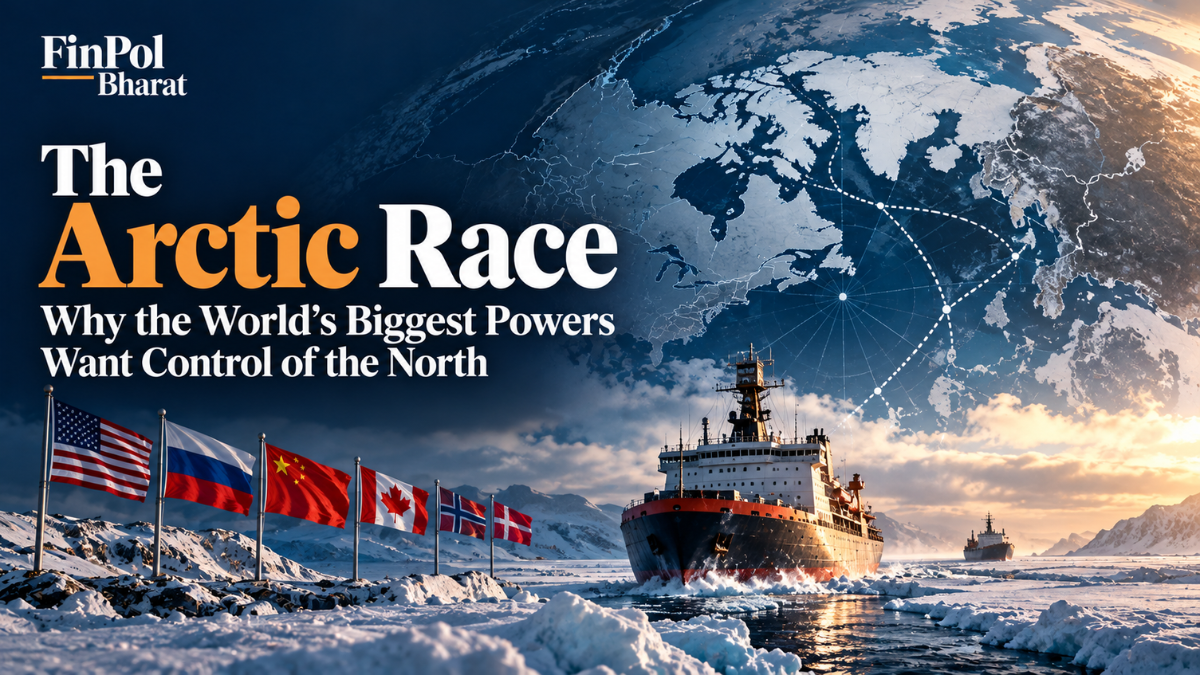
Discover why the Arctic is becoming a geopolitical hotspot as the United States, Russia, China, and other powers compete over shipping routes, energy resources, military security, and strategic influence.
Introduction: Why the Arctic Matters More Than Ever
For centuries, the Arctic was viewed as one of the world’s most remote and inaccessible regions. Covered by sea ice for much of the year, it appeared far removed from the major economic and political centres of global power.
That perception is changing.
Rising temperatures, evolving maritime conditions, growing interest in natural resources, and increasing military competition are making the Arctic more strategically significant. Governments are paying closer attention to its shipping routes, energy potential, critical minerals, military geography, and role in global climate systems.
The region has become an important arena of competition involving the United States, Russia, China, and the countries that border the Arctic Ocean.
However, the Arctic is not simply an unexplored territory waiting to be divided. It is a complex region governed by international law, overlapping maritime interests, existing territorial arrangements, and the rights of Indigenous peoples who have lived there for generations.
The central question is therefore not whether the Arctic will become more important, but how countries will manage their competing interests as its economic and strategic conditions change.
1. Understanding the Geography of the Arctic
The Arctic is a northern polar region generally defined by the Arctic Circle, although scientific and policy institutions sometimes use different boundaries based on climate, ecosystems, or human geography.
Eight countries are commonly identified as Arctic states:
- United States, through Alaska
- Russia
- Canada
- Denmark, through Greenland
- Norway
- Sweden
- Finland
- Iceland
These countries have different geographical positions and strategic interests. Russia possesses an extensive Arctic coastline, the United States has a significant presence through Alaska, and Canada and Denmark have important interests in Arctic waters and northern territories.
Finland and Sweden have Arctic territories but no coastline on the Arctic Ocean. Iceland occupies a strategically important position in the North Atlantic and the wider Arctic region.
The Arctic is also home to Indigenous peoples, communities, fisheries, wildlife, and ecosystems that are particularly vulnerable to environmental change.
Its geography matters because the region connects North America, Europe, and Asia through northern maritime approaches. It also contains areas relevant to military early-warning systems, submarine operations, satellite communications, and global transportation.
The Arctic’s strategic importance therefore extends far beyond the resources beneath its seabed.
2. Climate Change Is Reshaping the Strategic Landscape
Climate change is one of the most important factors altering the Arctic’s economic and geopolitical significance.
According to NOAA’s Arctic Report Card 2025, the Arctic experienced its warmest annual surface air temperatures in the observational record dating back to 1900 for the period from October 2024 through September 2025. In March 2025, Arctic winter sea ice reached its lowest annual maximum extent in the 47-year satellite record. <Cite refs={[“turn399546search0″,”turn399546search3”]}/>
Declining sea ice can make some maritime areas more accessible during certain seasons. It can also change the cost, duration, and feasibility of shipping operations.
But the consequences are more complicated than a simple opening of the Arctic to commerce.
Sea ice remains variable, weather conditions can be severe, and navigation may require specialised vessels, icebreakers, satellite support, and emergency infrastructure. Melting ice does not eliminate the risks associated with operating in remote polar waters.
Climate change also threatens Arctic communities, wildlife, infrastructure, and traditional livelihoods. Permafrost thaw can damage buildings and transport networks, while changes in ocean conditions affect marine ecosystems.
This creates a difficult policy dilemma: the same environmental changes that may increase access to certain economic opportunities also create substantial ecological and social costs.
For governments, Arctic strategy must therefore account for both commercial potential and environmental risk.
3. Why the United States Wants a Stronger Arctic Position
The United States considers the Arctic important for national defence, maritime access, resource development, and competition with strategic rivals.
Alaska gives Washington a direct geographical presence in the region. The Arctic also forms part of the wider strategic environment connecting North America with Europe and the North Atlantic.
Military planners are concerned about missile warning, air and maritime surveillance, submarine activity, and the protection of critical infrastructure.
The region’s geography is especially relevant because strategic aircraft and missile trajectories between parts of North America and Eurasia can involve Arctic approaches.
The United States also has economic interests in Alaska, including energy resources and potential mineral development.
Greenland has become another major focus of American strategic attention. Its geographical position between North America and Europe makes it relevant to defence systems, maritime monitoring, and North Atlantic security.
However, Greenland is an autonomous territory within the Kingdom of Denmark. Its population and political institutions have their own interests, and questions concerning its future cannot be understood simply through the strategic preferences of outside powers.
For Washington, the challenge is to strengthen Arctic security and infrastructure while maintaining cooperation with allies and respecting the political rights of Arctic communities.
4. Russia’s Arctic Strategy: Resources, Shipping, and Military Security
Russia has some of the largest Arctic territories and one of the most extensive Arctic coastlines in the world. The region plays an important role in its energy industry, maritime strategy, and national security.
Several factors explain Moscow’s interest.
Energy production
Russia’s Arctic territories contain significant oil and natural gas resources. Energy projects in the region contribute to its broader production and export ambitions, although development is constrained by costs, technology requirements, infrastructure, sanctions, and environmental conditions.
The United States Geological Survey estimated in a 2008 assessment that the Arctic could contain approximately 90 billion barrels of undiscovered technically recoverable conventional oil and 1,669 trillion cubic feet of natural gas. These are estimates of undiscovered resources, not proven reserves or quantities that can necessarily be produced economically. <Cite refs={[“turn399546search1″,”turn399546search2”]}/>
The distinction is important because resource potential does not automatically translate into profitable production.
The Northern Sea Route
Russia has invested in the Northern Sea Route, which runs along its Arctic coastline. The route could provide an alternative for certain shipments between parts of Europe and Asia when conditions permit.
However, its commercial value depends on seasonal ice, transit regulations, icebreaker availability, insurance costs, port infrastructure, and the reliability of shipping schedules.
It should not be assumed that the route will automatically replace established maritime corridors such as the Suez Canal.
Military infrastructure
Russia has also developed military infrastructure across parts of its Arctic territory. NATO identifies Russia’s expanded Arctic military activity and the strategic consequences of closer Russia-China cooperation as important security concerns. <Cite refs={[“turn399546search9”]}/>
For Moscow, the Arctic is simultaneously an economic region, a defensive perimeter, and a potential source of strategic leverage.
5. China’s Interest in the Arctic: A Near-Arctic Power
China does not border the Arctic Ocean, but it has increasingly sought a role in Arctic research, shipping, resource development, and international cooperation.
Beijing describes itself as a near-Arctic state. This is a political description rather than a geographical classification that gives China the same legal status as Arctic coastal states.
China’s interests include several areas.
Shipping and trade
The Arctic could provide alternative maritime routes for certain trade flows between Asia and Europe. Chinese policymakers and businesses have an interest in understanding whether these routes can become commercially useful.
Nevertheless, Arctic shipping remains subject to significant seasonal, operational, and economic limitations.
Energy and minerals
China is a major consumer of energy and an important participant in global mineral supply chains. Access to Arctic energy projects and selected raw materials could support its broader economic interests.
Such access depends on investment opportunities, local laws, international agreements, environmental requirements, and relationships with Arctic countries.
Scientific research and strategic influence
China has invested in polar research and has sought cooperation with Arctic states. Scientific activity can provide valuable knowledge about climate systems and the region’s environment, while also strengthening a country’s long-term presence and understanding of the area.
Western governments have expressed concern about the possible security implications of Chinese activity and cooperation with Russia.
At the same time, not every Chinese research or commercial activity should automatically be treated as a military operation. Individual projects must be assessed on their evidence, ownership, purpose, and strategic context.
China’s challenge is to expand its Arctic role in a region where the coastal states retain important legal rights and where geopolitical mistrust can limit cooperation.
6. Greenland: Why One Island Has Global Strategic Importance
Greenland occupies a central position in discussions about Arctic security.
It is geographically close to North America and lies along important North Atlantic and Arctic approaches. Its location makes it relevant to missile warning, military surveillance, maritime monitoring, and transatlantic defence.
The island also has mineral potential, including deposits that have attracted interest amid growing competition over critical raw materials.
However, mineral potential should not be confused with commercially viable production. Infrastructure, transport, energy availability, environmental regulation, financing, and local consent all affect whether projects can proceed.
Greenland’s political status is equally important.
It is an autonomous territory within the Kingdom of Denmark, with extensive self-government. Decisions about its future involve Greenland’s population and institutions, not merely the preferences of the United States or other external powers.
The strategic interest in Greenland demonstrates a broader principle of Arctic geopolitics: geography can make a territory internationally important, but strategic value does not erase the rights of its people.
7. The Arctic Shipping Race: Could Northern Routes Change Global Trade?
One of the most widely discussed economic possibilities in the Arctic is the emergence of more usable northern shipping routes.
Three routes are especially relevant:
The Northern Sea Route: Runs along Russia’s Arctic coast and is influenced by Russian regulation and infrastructure.
The Northwest Passage: Passes through the Canadian Arctic archipelago. Its navigability varies, and its legal status has been the subject of disagreement between Canada and the United States.
The Transpolar Sea Route: Would cross the central Arctic Ocean. Its commercial practicality remains highly uncertain and would depend on future ice conditions, vessel capabilities, infrastructure, and regulation.
These routes attract attention because they may shorten some journeys between selected ports compared with conventional routes.
But shorter geographical distance does not always mean lower total cost.
Shipping companies must consider insurance, ice-class vessels, escort services, fuel consumption, port availability, emergency response, cargo volumes, and schedule reliability. A route that saves distance may still be commercially unattractive if these additional costs are too high.
Arctic routes are therefore more likely to complement established shipping corridors than to replace them universally in the near term.
Their future importance will depend on actual commercial performance, not just the possibility of reduced transit distances.
8. Natural Resources: Opportunity and Economic Risk
The Arctic attracts interest because of its potential oil, natural gas, and mineral resources.
However, developing these resources is exceptionally challenging.
Projects may require costly offshore infrastructure, specialised equipment, reliable transport links, and technologies capable of operating in extreme conditions. Environmental regulation and the risk of spills or other accidents can add further complexity.
Climate change may make some areas more accessible, but it can also destabilise infrastructure through permafrost thaw and increase environmental uncertainty.
There is also a commercial risk: investments in long-lived fossil fuel infrastructure must be assessed against changing energy demand, climate policies, technological developments, and the possibility of lower future prices.
The resource question is therefore not simply whether the Arctic contains valuable materials. It is whether extraction can be conducted safely, legally, economically, and with acceptable environmental consequences.
Governments and companies that underestimate these constraints may find that technically recoverable resources are not commercially attractive.
9. Military Competition and the Risk of Escalation
The Arctic’s growing strategic importance has encouraged countries to pay closer attention to military readiness and surveillance.
NATO describes the region as strategically significant because it connects North America and Europe and hosts important maritime, transport, and communication links. The alliance has also highlighted Russia’s military presence and the implications of growing Russia-China cooperation. <Cite refs={[“turn399546search9”]}/>
Military activities in the Arctic can include air patrols, maritime surveillance, submarine operations, exercises, early-warning systems, and the protection of infrastructure.
The region’s harsh environment creates additional operational challenges. Poor weather, limited communications, long distances, and restricted emergency support can make even routine military operations difficult.
There are also risks of miscalculation. An exercise, surveillance operation, or encounter between military aircraft and vessels may be interpreted differently by competing governments.
However, military competition does not make conflict inevitable. Communication channels, clear operating procedures, transparency, diplomatic engagement, and functioning international institutions can reduce the risks.
The long-term objective should be to ensure that legitimate defence requirements do not produce an escalating cycle of suspicion and confrontation.
10. International Law: Who Actually Controls the Arctic?
The idea that the world’s biggest powers can simply claim the Arctic is misleading.
The legal framework is more complicated.
The United Nations Convention on the Law of the Sea (UNCLOS) establishes rules governing maritime zones, navigation, resource rights, and continental shelves. Coastal states have sovereign rights over resources within their exclusive economic zones, generally extending up to 200 nautical miles from their baselines, subject to the convention’s provisions.
Under specified conditions, a coastal state may establish rights over the seabed and subsoil of an extended continental shelf beyond 200 nautical miles. Such rights do not amount to sovereignty over the entire water column or the high seas.
This distinction matters because the Arctic Ocean contains areas where maritime boundaries, continental shelf claims, and navigation rules require careful legal analysis.
The Arctic Council also provides a forum for cooperation among the eight Arctic states, with the participation of Indigenous peoples through its Permanent Participants. Its work covers environmental protection, sustainable development, and regional cooperation. It is not a military alliance and does not settle every territorial or maritime dispute.
International law does not remove all disagreements, but it provides procedures through which states can clarify claims and manage competing interests.
11. The Environmental Cost of the Arctic Race
The Arctic is not an empty economic frontier. It is a sensitive ecological region that plays an important role in the global climate system.
Declining sea ice reduces the reflective surface that helps return solar energy to space. Changes in ocean temperatures, freshwater flows, and ecosystems can affect marine life and wider climate processes.
Industrial expansion introduces additional risks, including pollution, habitat disturbance, shipping accidents, and pressure on wildlife.
Oil spills in remote Arctic waters would be particularly difficult to contain because of low temperatures, limited infrastructure, and challenging weather conditions.
Indigenous communities also face changes to traditional hunting, fishing, travel, and subsistence practices as ecosystems and ice conditions change.
A serious Arctic strategy must therefore include environmental monitoring, emergency preparedness, community consultation, sustainable infrastructure, and strong standards for commercial activity.
The region’s strategic value cannot be measured solely in barrels of oil, mineral deposits, or shipping revenue. Its environmental stability also matters to the rest of the world.
12. What the Arctic Race Means for the Global Economy
The Arctic’s transformation could affect the global economy in several ways.
First, changes in maritime access could create additional options for selected shipping and logistics operations.
Second, resource development could influence energy and mineral markets, although actual production will depend on commercial and regulatory conditions.
Third, increased military competition could raise defence expenditure and create new requirements for surveillance, communications, and specialised infrastructure.
Fourth, environmental changes in the Arctic could affect fisheries, coastal communities, global sea levels, and the economic costs of climate change.
Finally, the region may become another area in which countries compete to secure supply chains and strategic partnerships.
These outcomes will not occur uniformly. Some opportunities may materialise, while others may prove too costly or environmentally damaging.
For businesses and policymakers, the appropriate response is to monitor actual developments rather than assume that a rapidly warming Arctic will automatically become a major commercial highway or resource boom.
Conclusion: The Arctic Is Becoming a Test of Global Cooperation
The Arctic is increasingly important because geography, climate change, natural resources, shipping, and military security are converging in one region.
The United States seeks to protect its northern approaches and strengthen its strategic position. Russia aims to preserve its regional influence, develop resources, and protect its Arctic interests. China is pursuing scientific, economic, and diplomatic opportunities despite not being an Arctic coastal state. Other Arctic countries are balancing sovereignty, security, economic development, and environmental protection.
Yet the region’s future will not be determined by military power alone.
Commercial investment must overcome severe operational constraints. Resource development must account for economic and environmental risks. Maritime disagreements must be managed through international law, and Indigenous communities must have a meaningful role in decisions that affect their territories and livelihoods.
The most important question is not simply which country will gain the greatest influence over the Arctic.
It is whether governments can manage their competing interests without undermining the environmental systems, legal frameworks, and regional stability on which the Arctic’s future depends.
The Arctic race is ultimately a test of how the world handles strategic competition in an era of environmental change.
Frequently Asked Questions (FAQs)
1. Why is the Arctic becoming geopolitically important?
The Arctic is gaining importance because of changing sea-ice conditions, potential shipping routes, natural resources, military geography, and competition among major powers for strategic influence.
2. Which countries have Arctic territories?
The eight Arctic states are the United States, Russia, Canada, Denmark, Norway, Sweden, Finland, and Iceland.
3. Why is China interested in the Arctic?
China is interested in polar research, shipping opportunities, energy resources, minerals, and international cooperation. It is not an Arctic coastal state, and its activities remain subject to applicable international law and the rights of Arctic states.
4. Could Arctic shipping replace the Suez Canal?
Not universally in the foreseeable future. Arctic routes may be useful for selected journeys, but seasonal ice, operating costs, insurance, infrastructure limitations, and schedule reliability constrain their commercial appeal.
5. Does any country own the entire Arctic?
No. Different parts of the region are governed by territorial sovereignty, maritime zones, international law, and rules concerning the high seas. The Arctic is not a single territory that one country can claim in its entirety.
6. What are the biggest environmental risks in the Arctic?
Major risks include sea-ice loss, warming temperatures, permafrost thaw, ecosystem disruption, pollution, industrial accidents, and threats to Indigenous livelihoods.
7. Could competition in the Arctic lead to military conflict?
Competition increases the potential for tension and miscalculation, but conflict is not inevitable. Diplomacy, communication, international law, and practical cooperation can help reduce the risks.
Further Reading: Authoritative Sources
- NOAA Arctic Report Card — Research on Arctic temperatures, sea ice, ecosystems, and environmental change.
- NATO: Arctic Security — An overview of the region’s defence and security significance.
- U.S. Geological Survey: Arctic Oil and Gas Assessment — Estimates of undiscovered conventional oil and gas resources in the Arctic.
- United Nations Convention on the Law of the Sea — The international legal framework governing maritime zones and ocean rights.
- Arctic Council — Regional cooperation on environmental protection and sustainable development.
FinPol Bharat is an independent explanatory platform. This article analyses the Arctic through economic, geopolitical, legal, and environmental perspectives. Resource estimates, shipping prospects, and strategic assessments should be interpreted in their stated context rather than as guarantees of future outcomes.
