
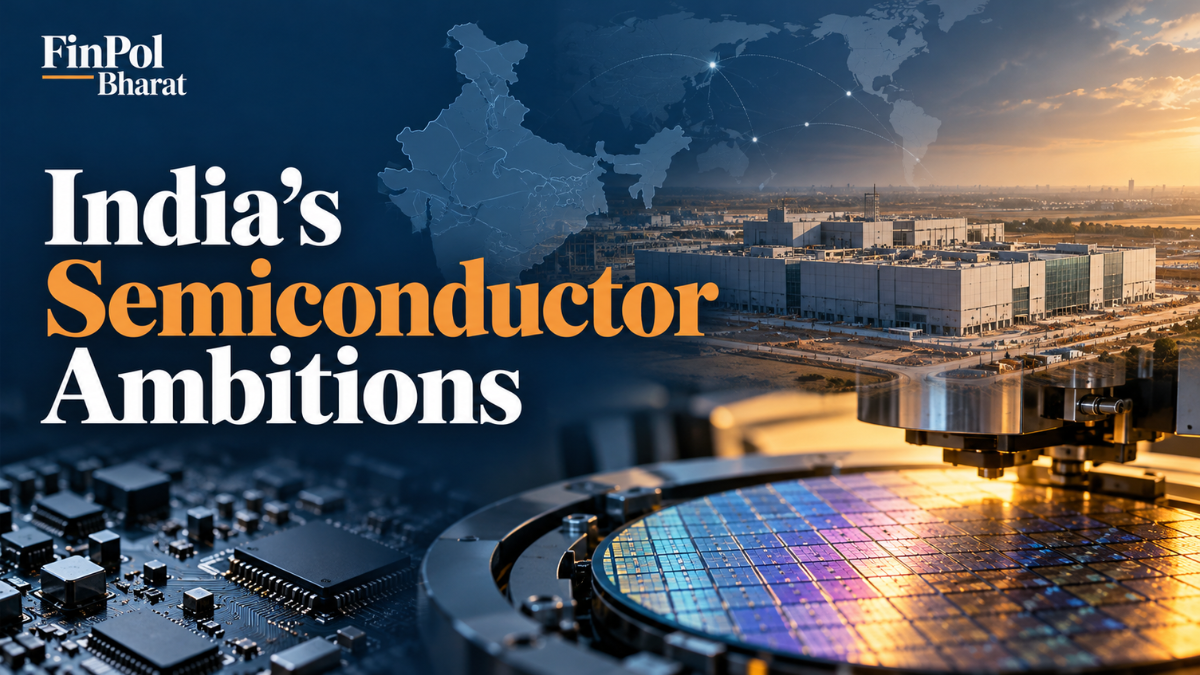
Explore India’s semiconductor strategy, the Dholera chip fabrication project, 28nm technology, global supply chain risks, and the challenges of building technological self-reliance.
Introduction: The Strategic Importance of Semiconductor Independence
Semiconductors have become one of the most strategically important components of the modern global economy. They power smartphones, automobiles, telecommunications networks, industrial machinery, data centres, medical equipment, and advanced defence systems.
As artificial intelligence expands and geopolitical competition intensifies, access to reliable semiconductor supplies is becoming an economic and national security priority. Countries that control critical stages of chip design, manufacturing, equipment production, and packaging possess significant advantages in the global technology ecosystem.
India presents an interesting case. The country has developed a substantial information technology industry and a strong pool of semiconductor design talent. However, building and scaling domestic chip manufacturing capabilities has remained a major challenge.
The government’s semiconductor initiatives, including the proposed fabrication facility at Dholera in Gujarat, represent an attempt to address this gap.
The central question is not simply whether India can manufacture chips. It is whether the country can develop a commercially competitive, technologically capable, and resilient semiconductor ecosystem that reduces strategic vulnerabilities without creating new dependencies.
1. From Food Security to Semiconductor Security
India’s experience with food security offers a useful historical comparison.
During the 1960s, India faced serious food shortages and depended on imported grain. Agricultural research, high-yielding crop varieties, improved farming practices, irrigation, and institutional support subsequently contributed to the Green Revolution.
The transformation demonstrated an important principle: reducing dependence on external suppliers requires more than financial investment. It requires domestic expertise, infrastructure, research, institutions, and sustained execution.
Semiconductors present a different and considerably more complex challenge.
Agriculture can benefit from widely adaptable technologies and locally developed practices. Semiconductor manufacturing, by contrast, requires highly specialised factories, extremely precise equipment, advanced materials, reliable utilities, intellectual property, and skilled engineers.
A modern fabrication facility also needs a network of suppliers capable of delivering specialised chemicals, gases, silicon wafers, components, and maintenance services to exacting specifications.
Consequently, semiconductor self-reliance cannot be achieved simply by constructing a factory. It requires the development of an interconnected industrial ecosystem.
India’s objective should therefore be understood as reducing critical vulnerabilities while building competitive domestic capabilities—not eliminating every form of international dependence.
2. Why Semiconductor Supply Chains Have Become a Geopolitical Issue
The semiconductor industry is globally interconnected, but its most advanced capabilities are concentrated among a relatively small number of companies and economies.
One country may specialise in chip design, another in manufacturing equipment, and another in wafer fabrication or packaging. This division of labour has enabled technological progress and economic efficiency, but it also creates vulnerabilities.
The 2025 dispute involving Dutch-headquartered chipmaker Nexperia illustrates this problem.
On September 30, 2025, the Dutch government invoked its Goods Availability Act in response to concerns about the company’s governance and the potential transfer of strategically important assets and technology. China subsequently imposed company-specific export restrictions affecting Nexperia’s Chinese operations. The dispute raised concerns among automotive manufacturers that depended on the company’s chips. <Cite refs={[“turn186474search5″,”turn186474news66″,”turn883990news34”]}/>
The episode demonstrated that supply chain disruption does not necessarily require a military confrontation. Government intervention, export controls, ownership disputes, or restrictions on a strategically important supplier can affect industrial production across multiple countries.
It is also important to understand what Nexperia represents. The company supplies many relatively mature semiconductor components used in automotive and electronic applications. These are not necessarily the advanced AI processors that attract the most public attention, but they remain essential to the functioning of complex products.
A shortage of a comparatively inexpensive component can delay the production of a much more expensive vehicle.
For India, the lesson is straightforward: supply chain resilience requires diversified suppliers, reliable access to critical components, domestic manufacturing capabilities, and better visibility into the origins of imported technology.
3. Why India Is Betting on 28nm Technology at Dholera
One of the most discussed elements of India’s semiconductor strategy is the Tata Electronics fabrication facility being developed at Dholera, Gujarat, in partnership with Taiwan’s Powerchip Semiconductor Manufacturing Corporation (PSMC).
The project was approved with an investment commitment of approximately ₹91,000 crore and a planned capacity of 50,000 wafer starts per month. Official project information identifies applications including high-performance computing and power management, with 28nm technology among the planned manufacturing capabilities.
At first glance, a focus on 28nm technology may appear less ambitious than the race to manufacture advanced chips using much smaller process nodes.
However, comparing semiconductor technologies exclusively by their nanometre labels misses the commercial and engineering realities of the industry.
What does 28nm mean?
The term “28nm” refers to a semiconductor manufacturing process generation. It is not a direct measurement of every physical feature on a modern chip, nor does it independently determine a processor’s performance.
Smaller process nodes can offer important advantages in transistor density, power efficiency, and performance, depending on the design and implementation. They are particularly important for many high-performance computing and advanced AI applications.
However, not every semiconductor application requires the newest process technology.
Mature process nodes remain useful for numerous automotive components, microcontrollers, power management systems, industrial electronics, connectivity products, and embedded applications.
The appropriate manufacturing technology depends on a chip’s intended function, reliability requirements, production volume, power consumption, and cost.
Why starting with mature technology can make sense
A country entering semiconductor fabrication faces several challenges simultaneously: manufacturing yields, process control, supplier development, workforce training, customer qualification, and commercial execution.
Attempting to compete immediately in the most advanced manufacturing segments would expose a new entrant to exceptionally high technological and financial barriers.
A facility targeting established process technologies can help build experience in manufacturing operations, quality assurance, customer relationships, and industrial supply chains.
Nevertheless, 28nm should not be treated as a universal solution. Demand for mature-node chips can fluctuate, and competing manufacturers already possess substantial experience. Commercial success will depend on production yields, customer demand, pricing, operational efficiency, and the ability to keep the facility technologically relevant.
The strategic question is not whether 28nm is old or new. It is whether India can manufacture the right chips reliably, competitively, and at scale.
4. Understanding India’s Semiconductor Mission
India’s semiconductor strategy is designed to develop capabilities across several stages of the value chain, rather than focusing exclusively on fabrication.
The Semicon India Programme has an announced government outlay of ₹76,000 crore. By February 2026, the government reported ten approved semiconductor projects across six states, representing envisaged investments of approximately ₹1.6 lakh crore. These figures describe approved projects and envisaged investments, not necessarily completed factories or money already spent. <Cite refs={[“turn186474search7”]}/>
The broader ecosystem includes several distinct activities.
Chip design
Design engineers develop the architectures, circuits, and layouts that determine how a chip functions. India already has a significant semiconductor design workforce, including engineers working for international technology companies.
However, a strong design workforce does not automatically translate into domestic manufacturing ownership, intellectual property ownership, or control over the entire production process.
Wafer fabrication
Fabrication is the process through which semiconductor circuits are manufactured on silicon wafers. It requires specialised equipment, highly controlled environments, complex production processes, and substantial capital investment.
Dholera is intended to expand India’s capabilities in this stage.
Assembly, testing, and packaging
After fabrication, chips often need to be assembled, tested, and packaged before they can be integrated into finished products.
These activities are essential to the semiconductor value chain. Packaging technology is also becoming increasingly important as chipmakers combine multiple dies and use advanced integration techniques.
Materials and manufacturing equipment
A resilient semiconductor industry also needs access to high-purity chemicals, specialised gases, silicon wafers, spare parts, process-control systems, and manufacturing equipment.
Some of these inputs may continue to come from international suppliers. The strategic objective is to ensure that critical inputs remain accessible through reliable and diversified supply chains.
India’s semiconductor strategy will be more successful if these different capabilities develop together.
5. The Role of Global Partnerships
Semiconductor manufacturing is too complex for most countries to develop entirely independently in a short period.
India’s partnerships with international companies are therefore an important part of its strategy.
The Dholera project involves Tata Electronics and Taiwan’s PSMC. In May 2026, the Indian government also announced an agreement between Tata Electronics and ASML, a Dutch supplier of advanced lithography equipment, to support the Dholera facility. <Cite refs={[“turn883990search1″,”turn883990search4”]}/>
These relationships can provide access to manufacturing expertise, equipment, process knowledge, and established industry practices.
However, foreign investment and domestic ownership should not be confused with complete technological independence.
A factory located in India may still rely on foreign equipment, imported materials, overseas intellectual property, international service providers, or technology partners.
This is not inherently a weakness. Even established semiconductor economies rely on international supply chains.
The more useful measure of progress is whether India gradually develops the skills, infrastructure, supplier base, research capacity, and commercial expertise needed to operate facilities reliably and negotiate from a stronger position.
International partnerships should accelerate domestic capability development rather than become a permanent substitute for it.
6. India’s Semiconductor Design Capabilities
India’s semiconductor opportunity is not limited to manufacturing.
The country has an established presence in chip design and engineering services. It is also developing indigenous processor initiatives intended to expand domestic capabilities.
One example is DHRUV64, a 64-bit dual-core microprocessor developed by the Centre for Development of Advanced Computing (C-DAC) and unveiled in December 2025. The initiative forms part of broader efforts to strengthen India’s processor development ecosystem.
Such initiatives matter because semiconductor capability includes more than operating a fabrication plant. It also includes designing processors, developing intellectual property, building tools and prototypes, validating chips, and integrating them into useful products.
Nevertheless, an important distinction must be maintained between developing a processor design and manufacturing it commercially at scale.
A domestic design can still depend on overseas fabrication, specialised electronic design automation software, third-party intellectual property, and imported equipment.
Similarly, an open instruction-set architecture does not automatically mean that every component of a processor is open-source or free from external dependencies.
India will need to connect its design talent with domestic manufacturing, research institutions, startups, product companies, and customers.
The ultimate objective should be to create an ecosystem in which Indian-developed designs can become commercially viable products, not merely successful research demonstrations.
7. The “Silicon Shield”: Can Semiconductor Dependence Prevent Conflict?
The term “silicon shield” describes the argument that Taiwan’s central role in advanced semiconductor manufacturing gives it strategic importance to the global economy.
The reasoning is that a disruption to Taiwan’s semiconductor industry could affect technology companies, automobile manufacturers, defence suppliers, and digital infrastructure around the world.
This creates economic incentives for major powers to avoid a conflict that could severely disrupt semiconductor production.
However, the concept should not be interpreted as a guarantee of peace. Economic interdependence can increase the cost of conflict, but it does not eliminate political or military risks.
Nor does dependence on a foreign-designed chip automatically mean that a country’s defence systems or banking networks are under another government’s direct control.
The actual risks depend on the system’s architecture, software, supply chain, security controls, update mechanisms, and the ability to maintain or replace compromised components.
Semiconductor security is therefore broader than the physical location of a factory.
For critical infrastructure, governments and businesses need secure chip designs, trusted suppliers, hardware testing, software assurance, inventory planning, and alternative sourcing arrangements.
India can improve its strategic position by expanding domestic capabilities while continuing to work with trusted international partners.
8. The Real Challenges Facing India’s Semiconductor Ambitions
The construction of a fabrication facility is a significant milestone, but it is only one part of the challenge.
High capital costs and financial risk
Semiconductor factories require enormous upfront investments. Their economics depend on utilisation rates, manufacturing yields, equipment costs, customer commitments, and the ability to compete with established global producers.
Public subsidies can help attract investment, but they do not guarantee commercial success.
Infrastructure reliability
Fabrication facilities need reliable electricity, high-quality water, specialised waste treatment, cleanroom systems, and dependable logistics.
Even brief interruptions or contamination events can create significant operational problems.
Skilled workforce development
India needs engineers and technicians trained in fabrication processes, equipment maintenance, process integration, quality control, packaging, and semiconductor materials.
Developing this expertise requires sustained cooperation between industry, universities, and research institutions.
Domestic demand and customer qualification
Manufacturers need customers willing to qualify their products and commit to purchasing chips.
Automotive and industrial customers may require extensive testing before adopting components from a new supplier. Establishing trust can take time.
Supply chain concentration
A domestic fab cannot eliminate dependence if critical chemicals, equipment, replacement parts, or manufacturing software remain vulnerable to concentrated overseas supply.
Diversification and domestic supplier development will therefore be as important as the factory itself.
Technology evolution
Demand for particular chip technologies can change as products and manufacturing processes evolve. India must ensure that its facilities serve commercially relevant markets and remain competitive throughout their operating lives.
The central risk is assuming that announcing a project is equivalent to establishing a sustainable industry. The more meaningful indicators are operational readiness, manufacturing yields, customer adoption, recurring production, exports, and the development of domestic expertise.
9. What Should India Measure to Determine Success?
Rather than judging semiconductor progress by investment announcements alone, India should evaluate its strategy using measurable outcomes.
| Indicator | Why it matters |
|---|---|
| Commercial production | Shows whether projects have moved beyond construction |
| Manufacturing yields | Indicates process reliability and operational efficiency |
| Domestic value addition | Measures how much value is created within India |
| Customer diversification | Reduces dependence on a small number of buyers |
| Local supplier development | Strengthens resilience against external disruptions |
| Design-to-manufacturing integration | Connects Indian research and engineering with commercial production |
| Export competitiveness | Tests whether manufacturers can compete internationally |
| Workforce development | Builds expertise that can support future projects |
These indicators should be tracked over time and compared with clearly defined project milestones.
India should also distinguish between domestic manufacturing capacity and domestic technological ownership. Both matter, but they measure different things.
For policymakers, the objective should be to build capabilities that remain useful even if individual projects experience delays, market downturns, or changes in international partnerships.
Conclusion: Semiconductor Self-Reliance Is a Long-Term Project
India’s semiconductor ambitions represent an important economic and strategic opportunity. The Dholera fabrication project, the expansion of assembly and packaging facilities, and initiatives in indigenous processor design can help the country establish a stronger position in the global semiconductor value chain.
The decision to pursue 28nm manufacturing should not be dismissed simply because more advanced process nodes exist. Mature technologies serve important industrial markets, and building manufacturing expertise can provide a foundation for future development.
However, neither a new factory nor an indigenous processor alone can deliver complete semiconductor independence.
Long-term success will depend on reliable production, competitive economics, skilled workers, strong research institutions, domestic supplier development, secure supply chains, and commercially successful products.
The Green Revolution provides a useful lesson about the value of sustained investment in domestic capabilities. But semiconductors demand a different approach: one built around global cooperation, specialised technology, industrial learning, and continuous innovation.
India does not need to manufacture every chip or replace every foreign supplier to strengthen its technological security. It needs to identify its most critical vulnerabilities, develop competitive capabilities in strategically important areas, and ensure that international dependencies do not become unacceptable points of failure.
The real test of India’s semiconductor strategy will not be how many factories it announces, but how reliably those factories produce competitive chips and how much lasting technological capability the country develops around them.
Frequently Asked Questions (FAQs)
1. Why is India investing in semiconductor manufacturing?
India is investing to strengthen domestic manufacturing, improve supply chain resilience, support electronics production, develop technical expertise, and reduce exposure to disruptions in critical imported components.
2. What is the Dholera semiconductor project?
The Dholera project is a proposed commercial semiconductor fabrication facility in Gujarat being developed by Tata Electronics in partnership with Taiwan’s PSMC. The project has an investment commitment of approximately ₹91,000 crore and a planned capacity of 50,000 wafer starts per month. Official information indicates that production is planned across technologies ranging from 110nm to 28nm. <Cite refs={[“turn883990search1″,”turn883990search6”]}/>
3. Why is India focusing on 28nm chips instead of advanced 2nm processors?
Different applications require different manufacturing technologies. Mature process nodes can serve automotive, industrial, power management, and other electronic applications. Advanced nodes are particularly important for many leading-edge computing products. The appropriate choice depends on market demand, cost, performance, and manufacturing capability.
4. Does manufacturing chips in India guarantee technological independence?
No. Domestic manufacturing can reduce certain vulnerabilities, but factories may still depend on imported equipment, materials, intellectual property, software, and foreign technical expertise. Technological resilience requires capabilities across the wider supply chain.
5. What is the significance of the Nexperia dispute?
The dispute between the Netherlands and China in 2025 demonstrated how government intervention and export restrictions can disrupt semiconductor supplies and create uncertainty for automotive manufacturers. It highlighted the importance of diversified sourcing and resilient supply chains. <Cite refs={[“turn186474news66″,”turn883990news34”]}/>
6. Can India become a global semiconductor leader?
India has opportunities in chip design, mature-node manufacturing, assembly, testing, packaging, and selected specialised technologies. Becoming a major global player will depend on commercial execution, manufacturing quality, customer demand, research, and sustained investment over many years.
Further Reading and Authoritative Sources
- India Semiconductor Mission — Government programme and semiconductor ecosystem initiatives.
- Press Information Bureau: Dholera Semiconductor Fab Agreement — Investment, capacity, and project details.
- Press Information Bureau: India’s Semiconductor Mission — Approved projects and programme developments.
- Government of the Netherlands: Nexperia Update — Official explanation of the Nexperia intervention and subsequent supply developments.
- C-DAC: Microprocessor Development — Information on India’s processor development ecosystem.
Editorial note: Project costs, capacities, approvals, and production schedules are subject to change. Readers should consult the latest official project disclosures before relying on forward-looking estimates.
